Our Articles
Facial Ageing and Dermal Fillers: Why a Whole-Face Approach Matters

Understanding how the face changes with age, and why personalised treatment goes beyond simply “filling a line”
One of the most common misconceptions about dermal fillers is that treatment is simply about filling wrinkles.
In reality, facial ageing is much more complex.
Our skin changes, but so do the underlying structures that support it. Volume and soft tissue distribution can change, and the proportions and contours of the face can gradually look different as we age.
This is why, at The Aesthetic Clinic, we believe a good aesthetic consultation should start by looking at your face as a whole, rather than immediately focusing on one wrinkle or deciding how many millilitres of filler you “need”.
What actually happens to our face as we age?
Ageing is a gradual and continuous process influenced by a combination of genetics, lifestyle and environmental factors.
The Allergan Aesthetics JUVÉDERM® educational material highlights changes that can occur in areas including the midface, nose, around the eyes and jawline. It also explains that the soft tissues of the midface can lose volume and descend with age.
The visual on page 4 illustrates this using what is sometimes called the “triangle of youth”. In a younger face, greater fullness through the cheek area creates a broader upper portion of the facial triangle. With age-related changes and loss of midface volume, those proportions can gradually shift.
This is an important concept because the area that bothers you isn’t always the only area that needs to be assessed.
For example, rather than immediately treating an individual fold or line, Dr Anton Mathey may first consider the surrounding facial structure, volume and proportions to understand what is contributing to the concern.
It’s not about chasing an “ideal” face
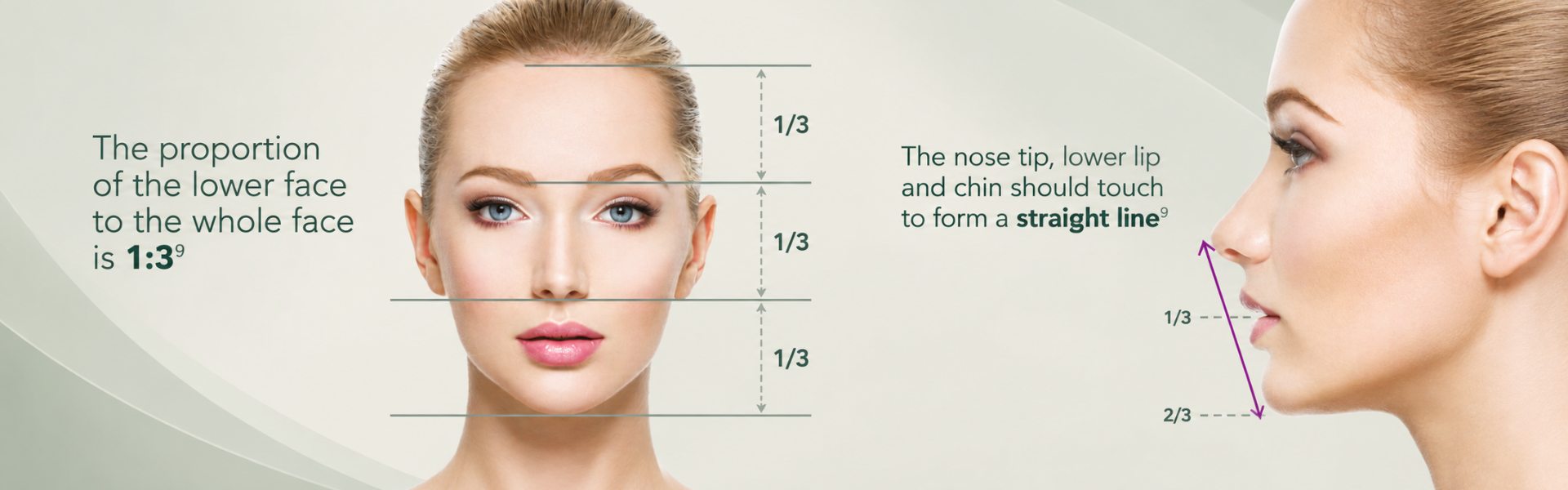
Facial proportions are frequently used in aesthetic medicine as useful assessment tools, but that does not mean every patient should be treated to fit one predetermined facial shape.
The diagram below, for example, demonstrates commonly referenced relationships between the upper, middle and lower thirds of the face, as well as the relationship between the nose, lips and chin.
These measurements can help practitioners assess facial balance, but your natural anatomy, age, sex, ethnicity, features and personal preferences all matter.
At The Aesthetic Clinic, the objective is therefore not to give everyone the same cheeks, lips, chin or jawline. It is to understand your individual facial anatomy and what you would like to achieve.
Where do hyaluronic acid fillers fit in?
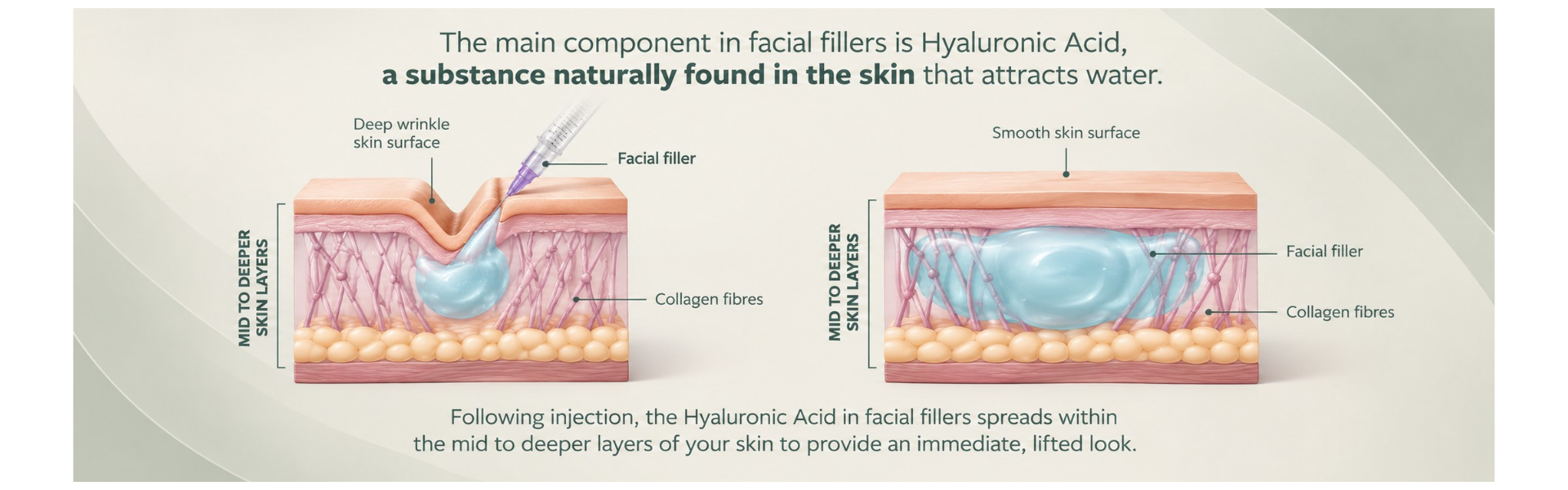
Hyaluronic acid (HA) is a substance naturally found in the skin that attracts water. When appropriately selected and administered, hyaluronic acid facial fillers can be used to address different aesthetic concerns.
The JUVÉDERM® range includes different products for different treatment areas and objectives.
For example, Allergan Aesthetics identifies JUVÉDERM® VOLUMA® for cheek volume and contour, JUVÉDERM® VOLUX® for jawline definition, and products including VOLIFT® and ULTRA formulations for the lips.
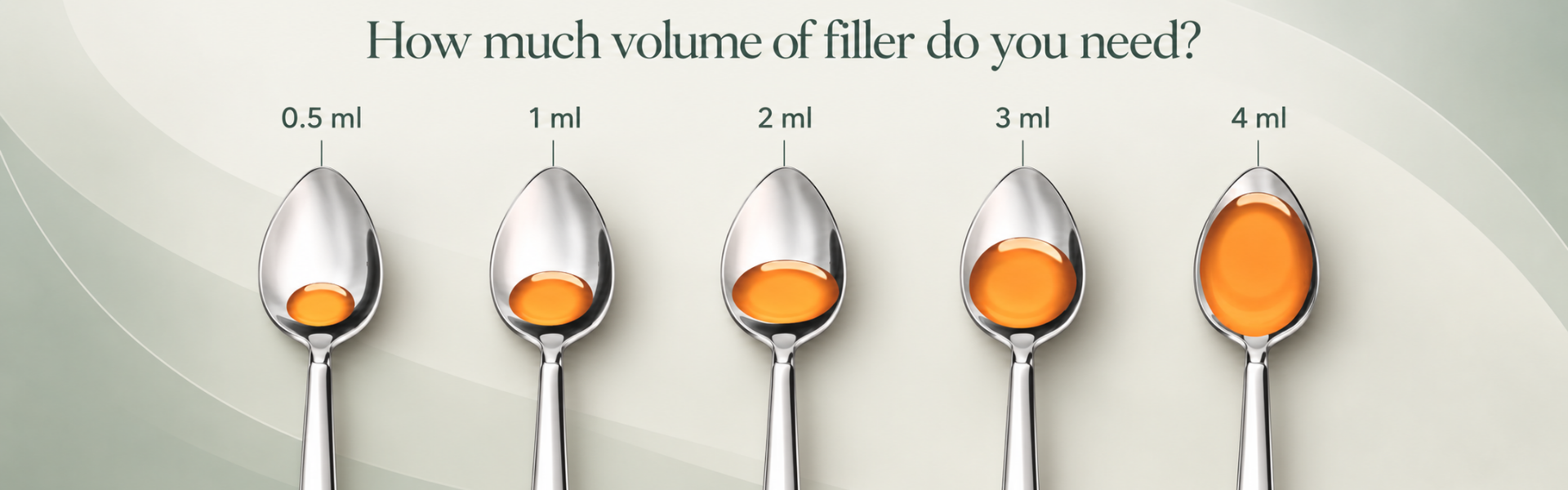
This is why asking, “How many millilitres of filler do I need?” before having your face assessed doesn’t necessarily give you the most useful starting point. Interestingly, the visual below compares 0.5 ml through to 4 ml using teaspoons. It is a useful reminder of what these quantities physically represent.
However, the appropriate amount cannot be determined from a generic chart. It depends on the area being treated, the product being used, your anatomy and your individual treatment objectives.
Cheeks and the midface
Changes in the cheeks and midface can influence the overall appearance of the face.
According to the source material, JUVÉDERM® VOLUMA® is designed to add volume beneath the skin’s surface, providing lift and contour to the cheek area.
For some patients, cheek treatment may therefore be considered when addressing age-related volume changes. For others, treatment may be intended to enhance existing facial contours.
Again, the objective and treatment plan will differ from patient to patient.
Chin and jawline
The lower face also contributes significantly to overall facial proportions.
JUVÉDERM® VOLUX® is an injectable gel designed to improve jawline definition in patients with moderate to severe loss of jawline definition.
When assessing the lower face, Dr Mathey may consider the chin, jawline and their relationship with the lips, nose and rest of the face rather than treating these features independently.
For patients interested in chin filler or jawline filler, this is why consultation and facial assessment are particularly valuable.
What about fine lines and skin quality?
Not every concern is about facial volume or structure.
According to the Allergan Aesthetics educational material, products within the JUVÉDERM® range may also be used to smooth fine lines and wrinkles, support skin hydration and elasticity, and lift or shape facial features, depending on the filler selected.
This gives a medical practitioner different tools for addressing different concerns.
The important distinction is that the treatment should be selected after identifying the concern, rather than choosing a product first and then deciding where to put it.
How long do JUVÉDERM® facial fillers last?
Dermal fillers are temporary.
According to Allergan Aesthetics’ JUVÉDERM® prescribing material, longevity across the range is approximately 9–24 months, depending on the product and area treated.
This doesn’t mean every patient will experience the same treatment longevity.
Ageing also continues after treatment. Genetics, lifestyle and environmental factors can continue to influence the skin and facial tissues. The source specifically identifies factors including sun damage, smoking and diet as influences on skin ageing and quality.
Maintenance treatment may therefore be required if you wish to maintain an effect over time.
Why consultation comes before treatment
Perhaps the most important part of any injectable treatment happens before the injection.
During your consultation, Dr Anton Mathey can assess your:
- Facial anatomy and proportions
- Areas of volume change
- Skin quality
- Treatment history
- Individual concerns
- Desired outcome
From there, he can recommend whether dermal filler is appropriate and, if so, which areas, products and quantities may be suitable.
Sometimes a patient who comes in asking about one treatment may benefit from a different approach altogether.
That is exactly why we don’t believe aesthetic medicine should be one-size-fits-all.
Considering dermal fillers in Pretoria?
If you’ve noticed changes in your cheeks, lips, chin, jawline or overall facial contours, or you’re simply unsure which aesthetic treatment may be suitable for you, the best place to start is a consultation.
Dr Anton Mathey offers individual consultations at The Aesthetic Clinic Waterkloof to assess your concerns and develop an appropriate treatment plan based on your unique needs.
Phone: 082 894 0967 / 012 346 1800
Email: dranton@theaestheticclinic.co.za
Contact The Aesthetic Clinic Waterkloof
Individual results vary. A comprehensive consultation with Dr Anton Mathey is required to determine the most appropriate treatment plan for your individual needs. A consultation fee applies to all bookings and will be waived if you proceed with your prescribed treatment following your consultation.
Sources
This article was developed for patient education by The Aesthetic Clinic, using educational and product information supplied by Allergan Aesthetics, an AbbVie company, in its Discover JUVÉDERM® Facial Fillers prescribing tool.
The original material draws on JUVÉDERM® product Directions for Use and published clinical literature, including research relating to hyaluronic acid, facial ageing, facial proportions and JUVÉDERM® products.
Sometimes a patient who comes in asking about one treatment may benefit from a different approach altogether.
That is exactly why we don’t believe aesthetic medicine should be one-size-fits-all.