Our Articles
BOTOX® Explained: Why Dose, Placement and Medical Expertise Matter

Understanding forehead lines, frown lines and crow’s feet, and why BOTOX® treatment should be tailored to your face
BOTOX® is one of the most recognised names in aesthetic medicine, but there is often much more to a well-planned BOTOX® treatment than simply deciding which wrinkles you would like to soften.
Where the product is placed, how much is used and how the different muscles of the upper face interact can all influence the outcome.
At The Aesthetic Clinic, Dr Anton Mathey approaches BOTOX® treatment individually. Your facial anatomy, muscle movement, areas of concern and desired outcome are assessed before your treatment plan is determined.
The aim is not to apply the same formula to every face. It is to use medical knowledge and appropriate treatment planning to achieve a balanced, natural-looking result.
What is BOTOX®?
BOTOX® is the Allergan Aesthetics brand of botulinum toxin type A. The source material supplied by Allergan Aesthetics describes BOTOX® as having an established clinical evidence base across therapeutic and aesthetic use.
In aesthetic medicine, BOTOX® may be used to temporarily reduce the appearance of certain facial lines associated with muscle movement.
It is important to distinguish BOTOX® from dermal fillers.
While fillers such as hyaluronic acid fillers can be used to restore or add volume, BOTOX® works differently and is used in relation to specific muscle activity.
Which treatment is appropriate therefore depends on what is causing your concern.
Which facial lines can be treated?
The Allergan Aesthetics prescribing material focuses on three commonly treated areas of the upper face:
- Forehead lines (FHL) are the horizontal lines that become visible across the forehead.
- Glabellar lines (GL) are the vertical frown lines that can develop between the eyebrows.
- Crow’s feet lines (CFL) are the lines that appear around the outer corners of the eyes, particularly when smiling or squinting.
Although we may talk about these as three separate treatment areas, the muscles involved don’t function independently of one another.
This is one of the reasons why Dr Mathey assesses the upper face as a whole before determining the most appropriate treatment plan.

Why BOTOX® dosage matters
One of the most useful parts of the Allergan Aesthetics prescribing guide is the treatment diagram below.
It illustrates recommended dosing across the forehead, glabellar and crow’s feet areas and describes the approach as a “tailored BOTOX® treatment for a balanced, natural look.”
For patients, there is an important lesson here:
- More BOTOX® does not automatically mean a better result.
- Neither does using as little product as possible.
- Appropriate dosing is a medical decision involving the treatment area, facial anatomy, muscle activity and the patient’s individual treatment goals.
This is why simply comparing the price “per unit” between clinics doesn’t necessarily tell you whether you are comparing equivalent treatments.
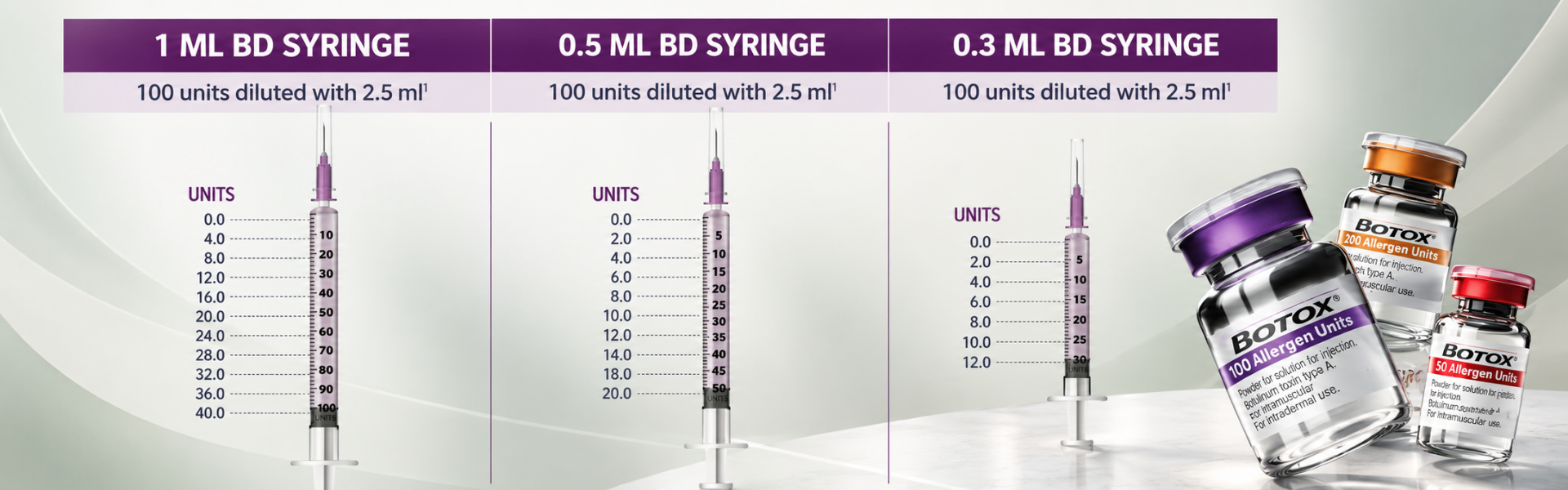
Why injection placement matters too
The amount of BOTOX® used is only one part of treatment.
Where it is placed matters.
The next diagram demonstrates multiple treatment points across the forehead, between the eyebrows and around the eyes. It also makes clear that practitioners should refer to the approved professional information for full recommendations on injection sites.
A medical practitioner therefore needs to understand the underlying anatomy and how the muscles responsible for facial expression work together.
Your natural eyebrow position, forehead height, muscle strength and movement patterns can all form part of the assessment before treatment.
At The Aesthetic Clinic, Dr Mathey combines his medical training with extensive experience in anti-ageing injectables to determine the appropriate treatment for each individual patient.
Will BOTOX® make my face look frozen?
This is one of the questions patients frequently ask us.
Aesthetic BOTOX® treatment does not have to be approached with the goal of removing every bit of facial expression.
Instead, treatment can be carefully planned around the areas that concern you and the outcome you would like to achieve.
Allergan Aesthetics specifically describes its recommended approach as tailored treatment for a balanced, natural look. That word, tailored, is important.
Two patients of a similar age may have completely different facial anatomy, muscle strength and aesthetic preferences. Their treatment plans therefore do not necessarily need to look the same.
Why consultation matters
You may know that your frown lines bother you. Or perhaps you’ve started noticing forehead lines in photographs. You may simply feel that the area around your eyes looks more tired than it used to.
Those are useful starting points for your consultation.
From there, Dr Mathey can assess how your face moves, the muscles contributing to those lines and whether BOTOX® is an appropriate treatment option.
Your consultation is also an opportunity to discuss what you don’t want.
If preserving natural movement is particularly important to you, tell us. If you have had injectable treatments previously, discuss what you liked or disliked about your results.
Good aesthetic treatment begins with understanding the patient, not simply the product.
Why the actual BOTOX® product matters
“BOTOX” is sometimes used casually as a general term for anti-wrinkle injections, but BOTOX® is a specific registered product.
The Allergan Aesthetics professional information states that BOTOX® contains botulinum toxin type A and importantly notes that botulinum toxin units are not interchangeable from one product to another. Doses expressed in Allergan units therefore cannot simply be assumed to be equivalent to those of another botulinum toxin preparation.
For patients, this reinforces the importance of knowing which product is being used, rather than assuming that all anti-wrinkle injectable treatments are identical.
Product + practitioner + personalised treatment
When considering BOTOX® treatment, we encourage patients to think beyond simply asking:
“How many units do I need?”
A better conversation considers three things together:
The product. The practitioner. The treatment plan.
The product should be appropriate for the indication. Your practitioner should understand facial anatomy, muscle movement, dosing and injection technique. And your treatment plan should reflect your individual face and your goals.
At The Aesthetic Clinic, this is the approach Dr Anton Mathey brings to every consultation.
Considering BOTOX® in Pretoria?
Whether you’re concerned about forehead lines, frown lines between the eyebrows or crow’s feet around the eyes, you don’t need to decide your treatment or dosage before coming to see us.
Book a consultation with Dr Anton Mathey at The Aesthetic Clinic Waterkloof to discuss your concerns and determine whether BOTOX® is appropriate for your individual needs.
Phone: 082 894 0967 / 012 346 1800
Email: dranton@theaestheticclinic.co.za
Contact The Aesthetic Clinic Waterkloof
Individual results vary. A comprehensive consultation with Dr Anton Mathey is required to determine the most appropriate treatment plan for your individual needs. A consultation fee applies to all bookings and will be waived if you proceed with your prescribed treatment following your consultation.
Sources
This article was developed for patient education by The Aesthetic Clinic using information supplied by Allergan Aesthetics, an AbbVie company, in its BOTOX® healthcare-professional discovery/prescribing material.
The source document cites the BOTOX® Professional Information (August 2024) together with published clinical literature and Allergan Aesthetics data on file. The Allergan material was published in December 2024.